Sixth Form Student Gives Speech at Royal Naval and Military Club
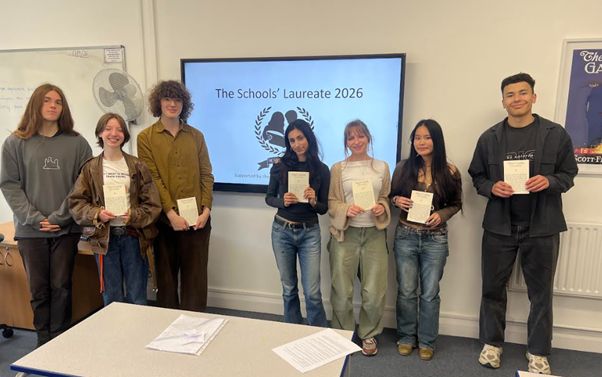
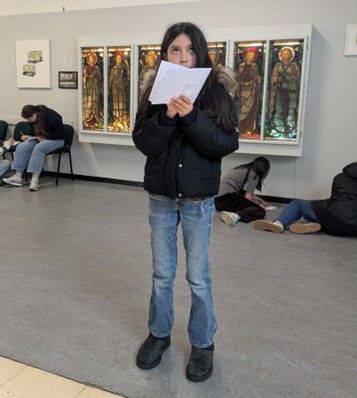
Two of our Y12 students recently took part in the Sovereign Minds Spear Oratory Prize for 16-18 year olds.
There were 2000 entrants, of which 200 got through to the quarter finals, 25 to the semi-finals, and 5 to the finals. Jacob and Eva got to the semi-finals.
This is the message we received from the organisers of the event:
Your students’ achievement in reaching this stage is truly exceptional, and you should be immensely proud of them. To stand out at this level reflects not only their confidence and clarity of thought, but also the support and encouragement they receive from their school.
Eva’s Speech:
How many children around the world do you think are missing out on a crucial, indispensable education? Think of a number. Is it hundreds? Thousands? Hundreds of thousands?
No.
Right now, across the globe, 260 million children are denied primary and secondary education. That is roughly 31% of the under-18 population. To put that into perspective, that is nearly four times the entire population of the United Kingdom, gone from the classroom.
An education that, for us here in London, feels unthinkable to lose—so secure, so permanent, so necessary. We wake up at seven, we complain about the cold, we brush our teeth, we rush out the door hoping not to miss the bus, and we sit in our classrooms, ready to learn. For us, school is a given. It is the background noise of our lives.
But that is not the reality for everyone. For millions of children, school is not a routine—it is a distant, flickering dream.
I remember standing next to a girl my age in Bangladesh, my father’s birthplace.
We were both just children, little girls. At that moment, we were mirrors of each other. We both smiled brightly; we both laughed at the same things and we both loved pink. To my eight-year-old self, the differences between us were invisible. I didn’t see a "privileged" child and an "underprivileged" child. I just saw a friend.
But as I grew older, I realised that while we started with the same joy, we were standing on two completely different paths shaped by these invisible differences. My path led back to a library in London, a secure education and a guaranteed seat in a university. Her path, in a country riddled by poverty and political instability, was far more precarious.
In Bangladesh, nearly one-fifth of all children drop out before completing primary school. Fewer than 44% finish secondary education. Think about that: more than half the children who start school with a dream of being a pilot, a teacher, a doctor or an artist will have that dream cut short before they even reach adulthood.
Why does this happen? And why should we, thousands of miles away, care?
Because without universal education, talent is the world's most wasted resource. When a child is denied a desk, inequality hardens into destiny. Poverty stops being a circumstance and starts being a cycle—reproducing itself across generations like a shadow you simply can’t lift.
But when you educate one child, you don't just help one person. You start a domino effect. An educated child is more likely to be healthy, more likely to find stable work, and more likely to ensure their children go to school. Education is the only tool we have that has the power to fight against background
We often hear adults say, “Children are the future.” It’s a nice sentiment. It looks good on posters. But the truth is this: the future is being failed by the present. Young people hold the key to what comes next.
If we say we believe in fairness, but we don't support universal education and deny millions the tools to succeed, we are being brutally dishonest. We must even out the playing field and allow every child a chance at their dreams, their goals, and their aspirations. A chance to hope.
By denying equal education, we are effectively locking that future away. We hold the key in our hands, but we keep it just out of reach for millions—impossible to grasp, impossible to turn.
There is hope in learning. There is a specific kind of power that comes when a child learns to read, to calculate, and to think critically. It is the power of freedom, the power of hope.
But what is hope if it isn’t shared? What is freedom if it’s a luxury for the few rather than a right for the many?
Education shapes more than just individual minds; it shapes the soul of our global culture. By making quality learning accessible to every child, everywhere—from the streets of London to the fishermen's villages of Bangladesh. We are shaping a world that is actually inclusive, rather than one that just pretends to be.
Every child deserves a chance at their dreams. A chance to hope. And most importantly, a chance to hold the key to their own future.